


Considerations
MOUD greatly reduces morbidity/mortality and pregnancy/delivery complications.
Severe withdrawal can harm the pregnancy/fetus and requires urgent treatment.
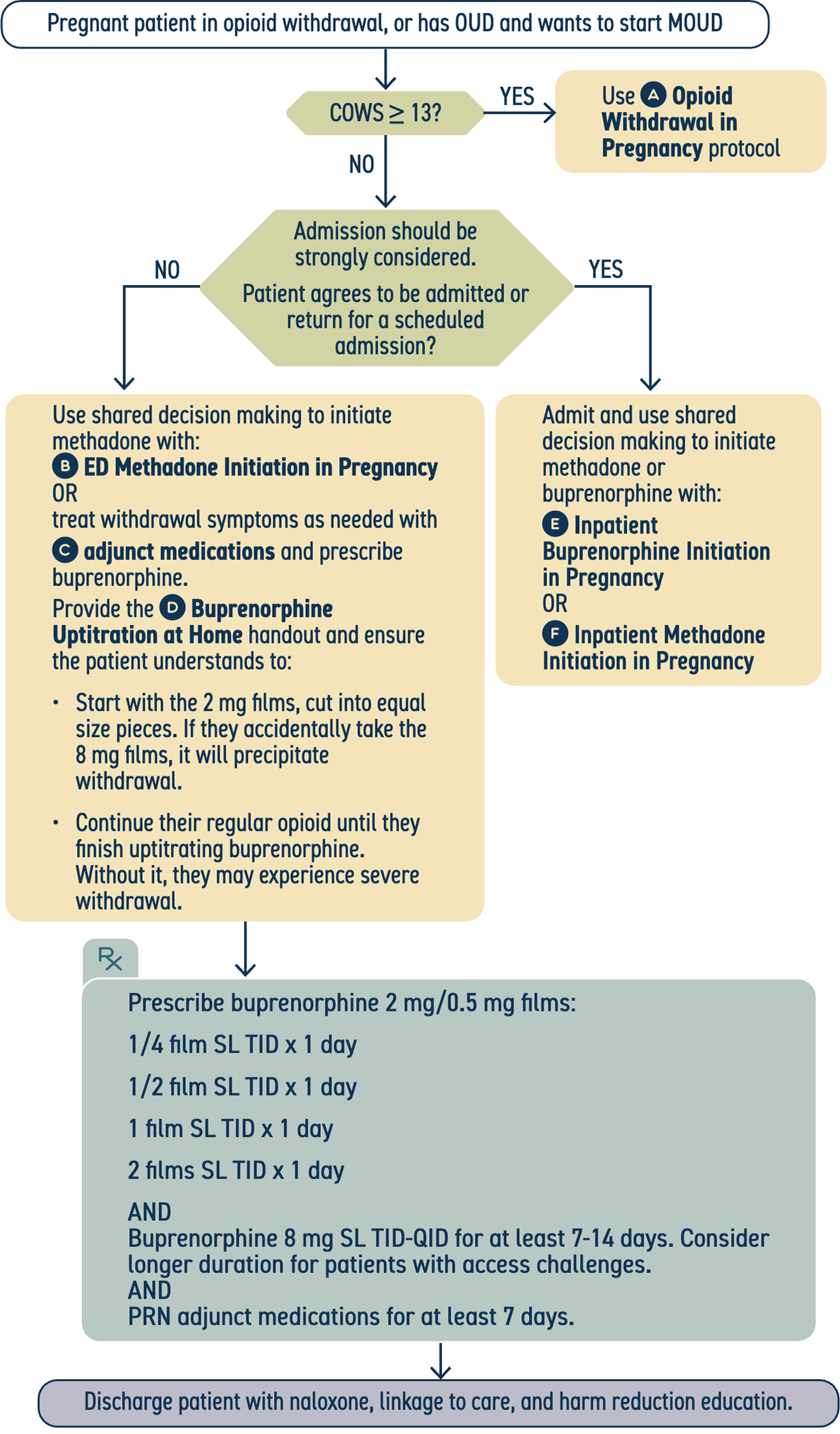
Admission should be strongly considered to stabilize high-risk pregnancy. Medicaid pays for medically necessary admissions.
Prescribe buprenorphine films (rather than tabs) for more accurate dose division.
Buprenorphine and buprenorphine/ naloxone are interchangeable in this protocol.
See Additional Clinical Guidance for more information.

Additional Clinical Guidance
- Opioid use disorder (OUD) is treatable.
- Buprenorphine reduces the risk of death by over 50%.
- Buprenorphine is a gold standard treatment for OUD in pregnancy and improves outcomes for the dyad. It is recommended by the American College of Obstetricians and Gynecologists (ACOG).
- Adjust dosing to minimize or eliminate withdrawal and opioid craving.
- Recovery commonly requires multiple treatment attempts.
- Swiftly and adequately manage withdrawal and OUD symptoms.
- Poor symptom management commonly results in patient-directed discharge, interrupting needed medical care and increasing risk of repeat admission, return to use, and overdose.
- Withdrawal may cause fetal distress and increases risk of preterm labor and other pregnancy and delivery complications.
- Risk of neonatal opioid withdrawal syndrome (NOWS) should not discourage buprenorphine.
- NOWS is an expected and treatable outcome for neonates chronically exposed to opioids in utero, including extra-medical and prescribed opioids.
- See Medications for OUD in Pregnancy & Postpartum for more information.
- Stigma against pregnant people with OUD prevents help-seeking and prenatal care.
- Recognize and challenge biases to provide compassionate, evidence-based care.
- Use non-stigmatizing, person-first language and trauma-informed care to promote engagement and improve outcomes.
- Substance use should not be conflated with child abuse/neglect. In Washington state, substance use alone does not constitute a mandatory report to Child Protective Services.
- When possible, connect patients with peer support to improve engagement.
- For complex cases, consult the Perinatal Psychiatry Consultation Line
- Available Monday- Friday (closed holidays), 9 AM-5 PM
- 877-725-4666, ppcl@uw.edu
Assessment
- Assess for and address other use disorders and withdrawal syndromes.
- Consider screening for sexually transmitted infections, including HIV, hepatitis C virus, syphilis, gonorrhea, and chlamydia. Consider linkage to PrEP as indicated.
Pain considerations
- Ensure pain and OUD symptoms are adequately controlled to prevent patient-directed discharge.
- Patients experience significant anxiety about pain.
- A caring, supportive approach is essential.
- Create a plan with the patient for what to do if their pain is not well controlled.
- Discussion of MOUD treatment options is more effective when pain and withdrawal are well-managed.
- Provide multimodal pain management and maximize non-opioid pain interventions. Consider acetaminophen, gabapentinoids, alpha-2 agonists, muscle relaxants, local anesthetics, pain dose ketamine, regional anesthesia, and nonpharmacologic approaches. See Adjunct Medications.
- Treat acute pain with opioids, when indicated.
- This does not worsen OUD.
- Patients with opioid tolerance may require significantly higher than typical doses of opioid analgesics to adequately control pain. See Opioid Dosing for Acute Pain in Patients with OUD and High Opioid Tolerance.
- Short acting, full agonist opioids can be used in combination with buprenorphine using this initiation method.
Labs
- Urine drug screening (UDS) is not needed to initiate treatment for OUD.
- UDS only indicates whether certain substances or their byproducts are present within a set detection window. It does not measure impairment, gauge severity of SUD, explain behavior, or rule out significant use when negative. It works best when it answers a specific clinical question and is part of a broader treatment plan.
- False-positives and false-negatives are not uncommon.
- If UDS is performed for clinical reasons, obtain informed consent.
- A positive UDS should not be conflated with child abuse or neglect.
- Support the dyad by providing evidence-based treatment and patient education.
- In Washington state, substance use alone does not constitute a mandatory report to Child Protective Services.
Pharmacotherapy
- Use shared decision-making to guide medication selection.
- Methadone
- Methadone is a long-acting, full opioid agonist with high receptor affinity.
- It suppresses opioid withdrawal symptoms and cravings by maintaining stable receptor occupancy throughout the day.
- Its high receptor affinity can block the effect of short-acting opioids, like fentanyl, unless overridden with high doses.
- Initiation doses are sub-therapeutic and dose escalation must be done slowly, as the sedating effects peak before the half-life stabilizes.
- Review drug-drug interactions before starting methadone.
- For more information about methadone, see the linked methadone protocols.
- Methadone is a long-acting, full opioid agonist with high receptor affinity.
- Buprenorphine
- Buprenorphine is a long-acting, partial opioid agonist with high receptor affinity.
- It suppresses opioid withdrawal symptoms and cravings by maintaining stable receptor occupancy throughout the day.
- It produces a lesser effect on the mu-opioid receptor compared to full agonists.
- It has a ceiling effect on respiratory drive, making respiratory depression unlikely even at very high doses. Combining it with other CNS depressants may increase risk.
- Its exceptionally high receptor affinity causes it to displace full agonists and block their effects.
- Because of this, full-dose buprenorphine can precipitate severe, acute withdrawal if initiated when full agonist opioids still occupy the receptor; patients must therefore either be in sufficient withdrawal before the first full dose, or use an up-titration method, as in this protocol, to slowly transition onto buprenorphine.
- Buprenorphine is a long-acting, partial opioid agonist with high receptor affinity.
- The uptitration method is preferred in pregnancy because it avoids withdrawal.
- This method creates a "ramp" onto buprenorphine over several days while maintaining a full agonist opioid.
- This gradual escalation avoids the sudden receptor displacement that causes precipitated withdrawal in standard buprenorphine initiation methods and eliminates the need for the patient to be in withdrawal beforehand.
- After achieving a therapeutic dose, typically 8 mg TID, the full agonist is stopped or tapered down.
- Withdrawal should be avoided in pregnancy, as it leads to fetal distress and increases risk of preterm labor and other pregnancy and delivery complications.
- This method is more successful when completed inpatient, as the complicated dosing regimen is difficult for patients to complete. However, if the patient does not agree to inpatient care, offering a home initiation is appropriate.
- Maintenance dose
- 8 mg TID-QID is recommended as an initial prescription while the patient stabilizes.
- A daily dose of at least 16-32 mg buprenorphine is considered effective for most patients.
- Buprenorphine metabolizes faster later in pregnancy. Patients may require higher doses or more frequent dosing (up to every 6 hours) to maintain therapeutic levels.
- Buprenorphine has a ceiling effect on respiratory drive, making respiratory depression unlikely even at very high doses. Combining it with other CNS depressants may increase risk.
- Higher doses do not increase the risk of neonatal opioid withdrawal and are safe for breastfeeding.
- Doses lower than 16 mg daily may be considered for patients with lower opioid tolerance. Tolerance may be lower if the patient:
- Does not need to use fentanyl multiple times daily to prevent/manage withdrawal.
- Is using an opioid that is less potent than fentanyl (e.g., oxycodone).
- Is an adolescent.
- Has been abstinent from opioids long enough that tolerance has meaningfully declined. This timeframe is variable in people who chronically use fentanyl, since it accumulates in adipose tissue and has slow clearance over several weeks or longer.
- Formulation
- “Buprenorphine” in this protocol refers to either the monoproduct (buprenorphine, brand name Subutex) or combination product (buprenorphine/naloxone, brand name Suboxone or Zubsolv).
- These formulations work interchangeably. Both are appropriate and effective.
- The monoproduct may require prior authorization and may only be covered by insurance in cases of pregnancy or adverse reaction to naloxone.
- Naloxone is present in the combination product solely to deter intravenous misuse. Naloxone is not well absorbed sublingually but is rapidly absorbed intravenously. Intravenous use precipitates withdrawal.
Pathophysiology
If a patient continues to use extra-medical opioids while on buprenorphine, a higher dose may be indicated to better manage OUD symptoms. Continued substance use is not a reason to stop treatment or consider it a failure. Buprenorphine significantly reduces the risk of all-cause mortality for people with OUD, even with continued extra-medical opioid use.
Special populations
- For more information on buprenorphine in pregnancy, see Medications for OUD in Pregnancy & Postpartum.
- Adolescents:
- Consent: In Washington State, youth age 13+ can consent to OUD treatment without parental consent (RCW 71.34.530).
- Consider expert consultation for pregnant adolescents.
- A sample uptitration dosing schedule is described in the Inpatient Buprenorphine Initiation in Pregnancy protocol under Special Populations. This can be adapted for home initiation.
Polysubstance use
- Polysubstance use is not a contraindication to MOUD.
- Stimulant use
- Stimulant withdrawal can cause sedation and hypersomnia that may be confused with over-sedation from methadone. See Assessment.
- Stimulant intoxication can mimic symptoms of opioid withdrawal, including dilated pupils, sweating, agitation, hypertension, tachycardia. Symptoms specific to opioid withdrawal include runny nose, yawning, and piloerection.
- Address withdrawal syndromes and other use disorders.
- Benzodiazepine and alcohol withdrawal must be monitored carefully and treated aggressively.
- Increase monitoring if treating withdrawal syndromes with other CNS depressants.
- Buprenorphine does not treat other withdrawal syndromes.
Administration
This section is focused on buprenorphine uptitration at home. If the patient will be admitted or is initiating methadone, see the appropriate linked protocol.
- Buprenorphine films are preferred over tablets because they allow for more precise, reliable dosing with the very small starting doses required for this method.
- To get the very small doses required, the manufacturer doses must be divided. In the inpatient setting, this is done by pharmacy.
- Films can be cut into more accurate, reproducible fractions (e.g., a 2 mg film cut into quarters for ~0.5 mg doses), whereas tablets crumble and fracture unevenly.
- The drug is evenly dispersed throughout a film, so each cut piece delivers a predictable proportion of the dose; split tablet fragments may deliver inconsistent amounts.
- Films adhere to the mucosa and dissolve in place, supporting more consistent sublingual absorption.
- Buprenorphine is administered sublingually. Ensure proper dosing technique:
- Keep the film under the tongue until fully dissolved.
- Do not talk, eat, drink, or smoke while it is dissolving.
- Do not eat or drink for 15 minutes after.
- To prevent tooth decay, rinse mouth with water 30 minutes after it has fully dissolved.
- If available, a peer or similar role can help by sitting with the patient throughout medication administration to remind them of proper technique.
Discharge planning
This section is focused on buprenorphine uptitration at home. If the patient will be admitted or is initiating methadone, see the appropriate linked protocol.
- Ensure the maintenance buprenorphine prescription provided lasts at least until the scheduled follow up appointment.
- If there is no appointment scheduled, provide at least 7-14 days to allow time for the patient to secure an appointment.
- Consider a longer duration in areas with access challenges.
- Prescribe adjunct medications for withdrawal.
- Patients commonly need adjunct medications to manage withdrawal symptoms until they stabilize on the medication.
- Prescription duration should be at least 7 days.
- Ensure the patient is discharged with naloxone in hand.
- In Washington, emergency departments are required to dispense naloxone to patients with OUD or those otherwise at risk of opioid overdose, in compliance with 2SSB 5195.
Patient education
- For shared decision-making resources to educate patients on MOUD options, see: https://scalanw.org/moud
- For buprenorphine uptitration at home, educate the patient on:
- Proper buprenorphine dosing technique
- Buprenorphine must be taken under the tongue to receive the benefit of the medication.
- Keep the film under the tongue until it is fully dissolved.
- Do not talk, eat, drink, or smoke while it is dissolving.
- Do not eat or drink for 15 minutes after.
- To prevent tooth decay, rinse mouth with water 30 minutes after it has fully dissolved.
- Overdose prevention
- Ensure the patient and their support system understand when and how to use naloxone.
- The risks of change in use patterns, which can alter tolerance and increase risk of opioid overdose.
- The risk of respiratory depression when combining buprenorphine with CNS depressants (“sedatives” or “downers”), including alcohol.
- See Discharge Instructions for additional overdose prevention strategies.
- Proper buprenorphine dosing technique
- Neonatal opioid withdrawal syndrome (NOWS)
- The baby may experience NOWS shortly after delivery. This is expected when taking buprenorphine, is treatable, and does not cause long-term health issues. It is much riskier to leave OUD untreated.
- Encourage the patient to discuss their MOUD treatment with their OB provider. The OB provider can help them plan for labor, delivery, and postpartum, including pain and NOWS management.
Linkage to care
- When possible, connect patients with social work, care navigation, and/or peer support to strengthen linkage to care.
- Help the patient schedule an appointment or inform them of walk-in availability, where available.
- Hospitals enrolled in ScalaNW can call the 24/7 appointment scheduling line and receive a confirmed date, time, and location for MOUD follow up appointment during the 10-minute phone call.
- Hospitals not enrolled in ScalaNW may contact known sites directly or use the Washington Recovery Helpline to locate providers.
- Ensure the patient is aware of the date, time and location for follow up.
- If there will be a delay in follow up care, the patient can contact the Washington Telebuprenorphine Program at (206) 289-0287 for a virtual visit for a bridge prescription.
Discharge Instructions
Information about buprenorphine
- Buprenorphine treats opioid use disorder. It helps end the cycle of use and withdrawal so you can feel more stable. It also reduces the risk of opioid overdose and death.
- How to take the medication
- Your medication may be a film or tablet.
- Do not swallow it. It will not work if it is swallowed.
- Place it under your tongue and allow it to completely dissolve.
- This can take 5-15 minutes.
- Drinking water before taking it can help it dissolve faster.
- Do not eat, drink, talk, or smoke while it is dissolving.
- Wait at least 15 minutes after it has dissolved before smoking, eating, or drinking.
- To prevent tooth decay, rinse your mouth with water after 30 minutes.
- Side effects are usually mild and improve over time. They may include constipation, sweating, headache, dizziness, trouble sleeping, nausea, and sleepiness. Tell your healthcare provider if you have these symptoms.
- Caution:
- Combining buprenorphine with other sedatives or “downers” can increase your risk of overdose. Don’t start or increase your normal amount of use of any “downers” (including alcohol, opioids like fentanyl, benzos like Xanax, and sleep or anxiety medications) while you get used to buprenorphine.
- Buprenorphine is an opioid. Suddenly stopping buprenorphine can cause withdrawal.
- Buprenorphine is safe in pregnancy and improves the health and safety of both you and your baby.
- Buprenorphine can help you reduce or stop other opioid use (like fentanyl), and avoid withdrawal, which is safer for you and the baby.
- The baby may experience opioid withdrawal shortly after birth. This is expected, treatable, and does not cause long-term health issues.
- Talk to your prenatal care provider about your methadone treatment. They will help you plan for the birth and postpartum period, including managing your pain and the baby’s withdrawal.
- Buprenorphine is also safe in breastfeeding and can help reduce the baby’s withdrawal symptoms shortly after birth.
- Buprenorphine-naloxone contains naloxone in addition to the buprenorphine. The naloxone is not absorbed when the medication is absorbed under the tongue. If the medication is injected, the naloxone will be absorbed and can cause severe opioid withdrawal.
Follow up care
- Follow up or establish care with a prenatal care provider. Getting regular prenatal care will help you have a healthier pregnancy and delivery.
- Follow up with a provider for buprenorphine as soon as possible after leaving the hospital so you can get continue your medication.
- This may be the same person as your prenatal care provider, or a primary care or addiction treatment provider.
- Go to the follow up appointment scheduled for you while you were in the hospital.
- If you don’t have an appointment, or you miss the appointment, or are otherwise not able to be seen before your medication runs out, call the WA Telebuprenorphine line at (206) 289-0287. They can help you get another prescription until you can be seen.
Overdose Prevention
- Using street drugs is risky. If you do use, reduce your risk of dying from an opioid overdose with the following:
- Naloxone (Narcan)
- Today you received naloxone or a prescription for naloxone. This is an opioid overdose reversal medication. It is safe to use on anyone you suspect is experiencing an opioid overdose.
- Visit stopoverdose.org or talk to your provider, nurse, or pharmacist to learn more.
- Try not to use alone
- If plan to use alone, call SafeSpot at 1-800-972-0590. SafeSpot is a 24/7, peer-led overdose detection and prevention hotline. They will send someone to help if you stop responding during a phone call.
- Start low & go slow
- You can't know the complete contents or strength of street drugs. If you plan to use, start with a small amount to see how it affects you. If you have low tolerance (such as after a period of not using), be extra cautious. If you decide to use more, slowly increase by using small amounts at a time.
- Watch and wait before next person uses
- If you’re with a group of people, take turns to see how the product is affecting people. Someone needs to be able to ask for help, if it’s needed.
- Avoid mixing drugs
- Mixing drugs increases your risk. If you do use multiple drugs, try to use one at a time and use less of each.
- Know the signs of opioid overdose and how to respond.
- If someone is unresponsive or has unusual or no breathing, call 911 and give them naloxone and rescue breaths.
- Always have naloxone
- Tell others you have it, where it is, when to use it.
- Treatment with methadone or buprenorphine
- These medications, if taken as directed, reduce the risk of death by over 50%.
- If you need help finding a treatment provider, call the Washington Recovery Helpline at 866-789-1511 or go to warecoveryhelpline.org.
- You can also start buprenorphine or get an urgent prescription with a phone visit by calling the WA Telebuprenorphine line at (206) 289-0287. Learn more at WAtelebupe.org.
 Copy Discharge Instructions
Additional Resources
- Perinatal Psychiatry Consultation Line for Providers (Perinatal PCL): https://perc.psychiatry.uw.edu/perinatal-pcl/
- Contact: 877-725-4666, ppcl@uw.edu, Available Monday- Friday (closed holidays), 9 AM-5 PM
- Academy of Perinatal Harm Reduction: https://www.perinatalharmreduction.org/
References
- American College of Emergency Physicians Clinical Policies Subcommittee (Writing Committee) on Opioids, Hatten BW, Cantrill SV, et al. Clinical Policy: Critical Issues Related to Opioids in Adult Patients Presenting to the Emergency Department. Ann Emerg Med. 2020;76(3):e13-e39. doi:10.1016/j.annemergmed.2020.06.049
- American College of Obstetricians and Gynecologists. Opioid use and opioid use disorder in pregnancy. ACOG Committee Opinion No. 711. Obstet Gynecol. 2017;130(2):e81-e94.
- Centers for Disease Control and Prevention. Opioid use disorder and pregnancy. Updated April 24, 2024. Accessed August 15, 2025. https://www.cdc.gov/pregnancy/opioids/treatment.html
- Chambers LC, Hallowell BD, Zullo AR, et al. Buprenorphine dose and time to discontinuation among patients with opioid use disorder in the era of fentanyl. JAMA Netw Open. 2023;6(9):e2334540. doi:10.1001/jamanetworkopen.2023.34540
- Cohen SM, Straus E, Fiellin DA, et al. Hospital-Based Methadone and Buprenorphine Initiation Practices by Addiction Consult Services. JAMA Netw Open. 2025;8(8):e2526077. Published 2025 Aug 1. doi:10.1001/jamanetworkopen.2025.26077
- Crotty K, Freedman KI, Kampman KM. Executive Summary of the Focused Update of the ASAM National Practice Guideline for the Treatment of Opioid Use Disorder. J Addict Med. 2020;14(2):99-112. doi:10.1097/ADM.0000000000000635
- D'Onofrio G, O'Connor PG, Pantalon MV, et al. Emergency department-initiated buprenorphine/naloxone treatment for opioid dependence: a randomized clinical trial. JAMA. 2015;313(16):1636-1644. doi:10.1001/jama.2015.3474
- Englander H, Thakrar AP, Bagley SM, Rolley T, Dong K, Hyshka E. Caring for Hospitalized Adults With Opioid Use Disorder in the Era of Fentanyl: A Review. JAMA Intern Med. 2024;184(6):691-701. doi:10.1001/jamainternmed.2023.7282
- Grande LA, Cundiff D, Greenwald MK, Murray M, Wright TE, Martin SA. Evidence on buprenorphine dose limits: a review. J Addict Med. 2023;17(5):509-516. doi:10.1097/ADM.0000000000001189
- Herring AA, Perrone J, Nelson LS. Managing opioid withdrawal in the emergency department with buprenorphine. Ann Emerg Med. 2019;73(5):481-487. doi:10.1016/j.annemergmed.2018.11.032
- Jones HE, Fischer G, Heil SH, et al. Maternal Opioid Treatment: Human Experimental Research (MOTHER) – approach, issues, and lessons learned. Addiction. 2012;107(suppl 1):28-35. doi:10.1111/j.1360-0443.2012.04036.x
- Khazanchi R, Wachman EM, Schiff DM, Modest A, Saia KA, Hsu HE. Mandatory child protective services reporting for substance-exposed newborns and peripartum outcomes: a difference-in-differences analysis. JAMA Pediatr. Published online May 6, 2024. doi:10.1001/jamapediatrics.2024.0903
- Link HM, Jones H, Miller L, Kaltenbach K, Seligman N. Buprenorphine-naloxone use in pregnancy: a systematic review and meta-analysis. Am J Obstet Gynecol MFM. 2020;2(3):100179. doi:10.1016/j.ajogmf.2020.100179
- Martin CE, Shadowen C, Thakkar B, et al. Buprenorphine dosing for the treatment of opioid use disorder through pregnancy and postpartum. Curr Treat Options Psychiatry. 2020;7(3):375-399. doi:10.1007/s40501-020-00221-z
- Min JE, Guerra-Alejos BC, Yan R, et al. Opioid coprescription through risk mitigation guidance and opioid agonist treatment receipt. JAMA Netw Open. 2024;7(5):e2411389. doi:10.1001/jamanetworkopen.2024.11389
- Patrick SW, Barfield WD, Poindexter BB, Committee on Fetus and Newborn, Committee on Substance Use and Prevention. Neonatal opioid withdrawal syndrome. Pediatrics. 2020;146(5):e2020029074. doi:10.1542/peds.2020-029074
- Reindel KL, DeAngelis MJ, Ferrara AS, et al. An exploratory study of Suboxone (buprenorphine/naloxone) film splitting: cutting methods, content uniformity, and stability. Int J Pharm Compd. 2019;23(3):258-263.
- Saia KA, Schiff D, Wachman EM, et al. Caring for pregnant women with opioid use disorder in the USA: expanding and improving treatment. Curr Obstet Gynecol Rep. 2016;5(3):257-263. doi:10.1007/s13669-016-0168-9
- Saxon AJ. Short-acting, full agonist opioids during initiation of opioid agonist treatment in the fentanyl era. JAMA Netw Open. 2024;7(5):e2411398. doi:10.1001/jamanetworkopen.2024.11398
- Young LW, Ounpraseuth ST, Merhar SL, et al; ACT NOW Collaborative. Eat, sleep, console approach or usual care for neonatal opioid withdrawal. N Engl J Med. 2023;388(25):2326-2337. doi:10.1056/NEJMoa2214470
- Washington State Department of Children, Youth, and Families. Plan of safe care: healthcare providers. DCYF website. Accessed August 14, 2025. https://www.dcyf.wa.gov/safety/plan-safe-care/Healthcare-Providers
- Zedler BK, Mann AL, Kim MM, et al. Buprenorphine compared with methadone to treat pregnant women with opioid use disorder: a systematic review and meta-analysis of safety in the mother, fetus and child. Addiction. 2016;111(12):2115-2128. doi:10.1111/add.13462


